
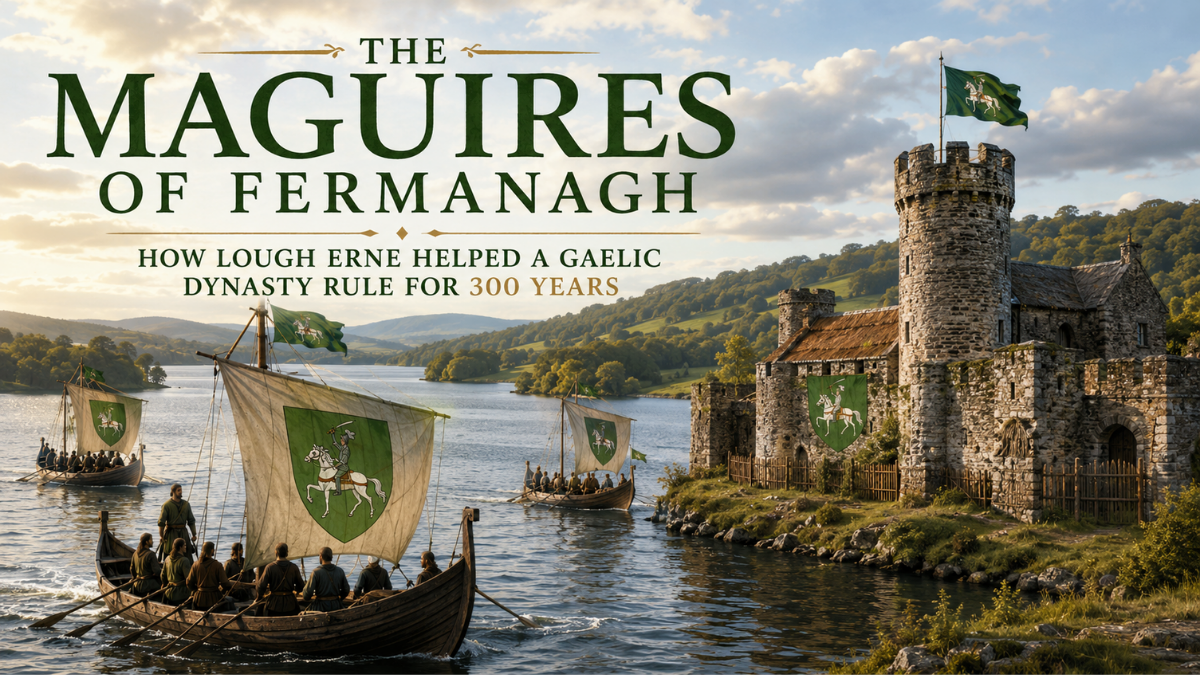
Today, Lough Erne is one of the defining features of County Fermanagh — a landscape of islands, sheltered bays and waterways stretching through the county with Enniskillen sitting between the Upper and Lower lakes.
But centuries ago, the lough was much more than part of the landscape.
It was a highway, a source of power and, when necessary, a formidable natural defence.
For the Maguires, the Gaelic family who dominated Fermanagh for more than 300 years, control of Lough Erne helped them control the territory around it.
They travelled its waters, maintained fleets of boats and established a stronghold at Enniskillen at one of the most strategically important points on the entire Erne system.
At the height of their power, contemporary poetry described a “forest of masts” on the Erne.
It offers a very different picture of medieval Fermanagh — not as an isolated corner of Ireland, but as a Gaelic lordship whose roads were often made of water.
The Rise of the Maguires
The name Maguire comes from the Irish Mág Uidhir, and the family’s connection with Fermanagh stretches back centuries.
By the end of the 13th century, the Maguires had emerged as the ruling dynasty of Gaelic Fermanagh. Their rule would continue for more than 300 years, into the opening years of the 17th century.
Their early centre of power was not Enniskillen, but in the south of the county around Lisnaskea.
Over time, however, another location became increasingly important.
Enniskillen.
And it isn’t difficult to understand why.
Look at Enniskillen on a map and its strategic value becomes immediately apparent.
The town developed on an island separating Upper and Lower Lough Erne. Anyone controlling this narrow point could exert influence over movement along one of Fermanagh’s most important natural transport routes.
In the early 15th century, Hugh “the Hospitable” Maguire established a stronghold at Enniskillen.
The exact construction date of Enniskillen Castle isn’t known, but evidence suggests it was built during the 1420s. Hugh died in 1428, while the earliest known written reference to the castle appears in the Annals of Ulster in 1439.
Enniskillen had become one of the centres of Maguire power.
A Fermanagh Where Water Was the Road
To understand the Maguires, it helps to forget the modern map of Fermanagh for a moment.
There were no modern roads linking Enniskillen with the surrounding towns and villages.
Instead, imagine the Erne system.
Lakes, rivers, islands and channels created a huge network running through the heart of the territory.
For an army unfamiliar with the landscape, that geography could present serious difficulties. For people who knew how to use it, however, the water provided an efficient means of travelling through Fermanagh.
The Maguires did exactly that.
Their boats weren’t simply used for fishing or carrying goods. Fleets could transport people and warriors and could be used as instruments of military power.
One of the most remarkable Maguire rulers was Philip of the Battle Axe, who ruled from 1363 until 1395.
Waterways Ireland describes his fleet of white-sailed boats on Lough Erne as one of his greatest military assets.
On one occasion, the Maguire fleet travelled beyond Lough Erne into Lough Oughter in County Cavan, where Philip captured an O’Reilly chief who subsequently became an ally.
This was a lordship that understood the military value of water.
A “Forest of Masts” on Lough Erne
Perhaps the most evocative evidence for the Maguire relationship with Lough Erne comes not from a battlefield, but from poetry.
A 15th-century poet described the scene on the Erne with the words:
“a forest of masts is on the Éirne.”
It is an extraordinary image.
Instead of the quiet stretches of water we might associate with parts of Lough Erne today, picture boats moving between settlements and islands, sails appearing across the lake and vessels gathering around Enniskillen.
Historical material collected by Waterways Ireland contains several references to Maguire fleets.
Thomas Óg Maguire, one of the powerful 15th-century rulers of Fermanagh, is recorded travelling by vessel through his territory while collecting tribute.
Later poetry from the 1580s presents another striking image of Enniskillen, describing so many ship masts beside the shore that they obscured the beach and referring to craftsmen associated with the vessels.
Claims have sometimes gone considerably further, including suggestions that the Maguires possessed as many as 1,500 boats.
That figure should be treated cautiously — even Waterways Ireland notes that it sounds exaggerated.
But the underlying story doesn’t require exaggeration.
There is strong evidence that boats and control of the waterways were an important part of Maguire power.
Was Lough Erne Really Protected by a Maguire “Navy”?
The Maguire fleet is sometimes described today as an inland navy.
It’s a wonderful description, but perhaps one that needs a little caution.
Calling it a formal “navy” in the modern sense risks giving the wrong impression. What we can say with much greater confidence is that successive Maguire rulers maintained and used significant fleets on Lough Erne for travel, warfare and the administration of their territory.
That alone makes the Maguire story unusual.
Fermanagh’s geography wasn’t simply something they had to overcome.
They turned it to their advantage.
And this helps explain why Enniskillen mattered so much.
The Castle at the Centre of the Lakes
Enniskillen Castle stood at the western end of the island, guarding the narrow waterway connecting Upper and Lower Lough Erne.
From here, the Maguires had a strategically positioned stronghold at the heart of their watery territory.
Its importance can be seen in how often people fought for it.
In 1508, Hugh O’Donnell attacked Enniskillen Castle with a fleet of boats, captured it and later returned and burned it.
The castle was destroyed again in 1538.
During the 1590s it repeatedly changed hands as Maguire and English forces fought for control.
Enniskillen Castle was therefore very different from the peaceful heritage attraction visitors know today.
For generations, this small part of Enniskillen was a contested military position.
Control the castle and you controlled one of the key strategic points in Fermanagh.
There is, however, an important detail about the castle people see today.
Its famous twin-turreted Watergate is not a surviving Maguire watergate.
The structure was developed after the decline of Maguire rule, when William Cole became Constable of Enniskillen Castle. By 1611, Cole was building on the foundations of the old castle, and the building now known as the Watergate had been completed by 1614.
Archaeological investigation has even found that, despite its modern name, the Watergate did not actually provide a gateway onto the water.
The Maguire story lies deeper in the site.
Fermanagh Was Also a Place of Learning
Maguire Fermanagh wasn’t defined only by warriors, castles and boats.
It was also part of Ireland’s sophisticated Gaelic learned culture.
Poets, historians, clerics, physicians and scribes worked within a society where powerful families could act as patrons of scholarship.
One of the greatest surviving examples connected with Fermanagh is the Annals of Ulster.
The annals were compiled under the patronage of Cathal Óg Mac Maghnusa Maguire, a prominent Fermanagh cleric, who commissioned local scholar Ruaidhri Ó Luinin to bring together material from earlier annals.
Another remarkable survivor is the Duanaire Mhéig Uidhir, or Maguire Poem Book.
Compiled for Cú Chonnacht Maguire, Lord of Fermanagh from 1566 to 1589, the collection preserves poems addressed to the Maguire lord and provides a window into the political and cultural world of 16th-century Fermanagh.
The original manuscript eventually travelled far from the county for which it was created.
Today, it is held in Copenhagen.
More than four centuries later, the words written for a Maguire ruler in Fermanagh survive hundreds of miles from Lough Erne.
The Beginning of the End
By the late 16th century, the political world that had allowed the Maguires to dominate Fermanagh was coming under enormous pressure.
The English Crown was extending its authority into Ulster.
In 1589, Hugh Maguire succeeded his father as Lord of Fermanagh.
Much of his territory was difficult to penetrate, with the Dictionary of Irish Biography describing a considerable portion of the lordship as being almost impregnable because of its location among the islands of Lough Erne.
But geography could only provide so much protection.
The Crown’s attempt to impose its administration on Fermanagh led to confrontation.
In 1593, Hugh Maguire openly rebelled.
What followed became part of the Nine Years’ War, the enormous struggle involving Maguire, Hugh O’Neill of Tyrone, Hugh Roe O’Donnell and the English Crown.
Once again, Enniskillen Castle became crucial.
English forces captured it.
The Maguires recaptured it.
It changed hands repeatedly.
The fighting around Enniskillen demonstrates just how important the location remained even as the medieval Gaelic world entered its final years.
Hugh Maguire himself became one of the leading military figures of the conflict.
He fought alongside O’Neill and O’Donnell and commanded forces during some of the most important episodes of the war, including the great Irish victory at the Yellow Ford in 1598.
His story ended far from Fermanagh.
In March 1600, while campaigning near Cork, Maguire encountered English officer Warham St Leger. St Leger shot Maguire, while Maguire struck St Leger with his lance.
Both men died from their injuries.
The Last Maguire Years at Enniskillen
Hugh was succeeded by his younger brother, Cú Chonnacht Óg Maguire.
The struggle continued.
In 1602, Cú Chonnacht had Enniskillen Castle destroyed to prevent English forces from using the strategically important site as a military base.
The Nine Years’ War ended the following year.
For a short time, there was still a possibility that the Maguires would retain substantial lands in Fermanagh. Cú Chonnacht was pardoned and arrangements were made to divide much of the county between rival Maguire branches.
But the old order would not survive.
In September 1607, Cú Chonnacht joined Hugh O’Neill, Rory O’Donnell and other members of the Gaelic nobility in leaving Ireland in the event remembered as the Flight of the Earls.
Cú Chonnacht had actually helped organise the ship on which they departed from Rathmullan.
His lands were subsequently confiscated.
The centuries of Maguire rule in Fermanagh had effectively come to an end.
The Fermanagh They Left Behind
More than 400 years later, it can be difficult to imagine just how different the Fermanagh of the Maguires would have looked.
Yet the geography that helped shape their world is still here.
Stand beside Enniskillen Castle and look towards the water.
Follow the Erne north towards Devenish and Lower Lough Erne, or south towards the maze of islands and waterways of the Upper Lough.
The landscape begins to explain the history.
For the Maguires, these waters weren’t simply scenery.
Lough Erne was their road, their defensive barrier and one of the foundations of their power.
Their boats moved through it.
Their strongholds guarded it.
Their rivals attacked across it.
Their poets wrote about the masts that filled it.
And at its strategic centre stood Enniskillen.
The modern town grew and changed enormously after the Maguire period, but its position between the two lakes remains exactly what made it important centuries ago.
Perhaps that is the most fascinating part of the Maguire story.
The same stretch of water that visitors photograph from Enniskillen today once lay at the heart of one of Gaelic Ireland’s most powerful lordships.


